‘Loose’ Recommendation
As I have already mentioned, there are multiple ways to approach and land the 737; ask several pilots and each opinion will be slightly different. Generally speaking, without alternate guidance from Air Traffic Control or an approach chart, the following recommendations should be adhered to. The aircraft should begin descent to the runway at:
Approximately 10 NM from the runway;
At approximately 3000 ft AFE;
Have flaps 1 extended; and,
Be flying at as airspeed no greater than 200 kias.
If the aircraft is following the ILS approach course, it is better to intercept the ILS glideslope slightly from below rather than above. Intercepting the glideslope from below enables greater control of airspeed.
Speed Management
Speed management is probably the most critical factor during any approach. A common saying is ‘you have to slow down to get down’. This said, it is a bit of a conundrum. The airline wants its pilots to optimise the aircraft’s airspeed for as long as possible, because this means less fuel use, less noise, and lower engine operation times.
Slowing the 737-800 aircraft is not easy when the aircraft is descending, so it is a good idea to begin to reduce the airspeed when the aircraft is in level flight prior to beginning the descent. The thrust levers should be brought to idle (idle thrust or near to) and the airspeed allowed to decay to the flaps UP manoeuvring speed. The flaps UP indication is displayed on the speed tape in the PFD. If speed reduction is initiated before reaching the IAF, the airspeed will decay naturally without excessive use of the speedbrake.
Important Points:
It requires approximately 25 seconds and 2 NM to decelerate the 737-800 from 280 kias to 250 kias, and it will take a little longer decelerating from 250 kias to 210 kias. More simply written, it takes approximately 1 NM to decrease airspeed by 10 kias in level flight.
The aircraft should begin slowing at 15 NM from the airport to be at 10 NM at 3000 ft AFE at a speed of approximately 190-200 kias with flaps 1 extended.
The aircraft’s airspeed should be reduced to flaps UP manoeuvring speed no later than the IAF.
Speedbrake, Flaps and Landing Gear Use
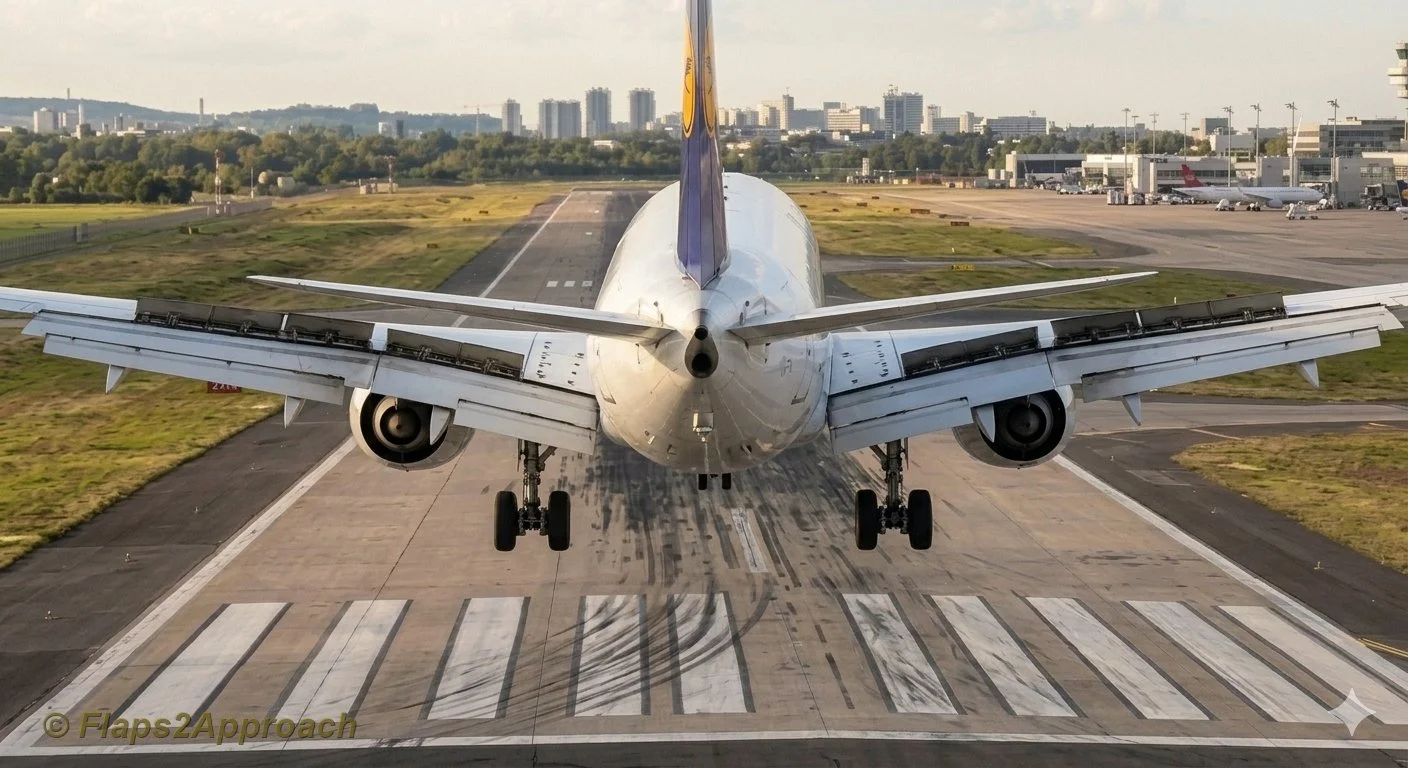
The transition from level flight to descent will be much easier, with less need to use the speedbrake, if the aircraft is already at a lower airspeed prior to the descent. If the speedbrake must be used, try to minimise its use at and beyond flaps 5. The speedbrake may be used with flaps 1, 2, 5, and 10, but it must not be extended beyond flaps 10 or used below 1000 feet AGL.
Although the speedbrake is designed to slow the aircraft, its use causes increased inside cabin buffeting and noise, decreases fuel efficiency, and can lead to unnecessary spooling of the engines; these factors are exacerbated if the aircraft is descending and travelling at a slower speed. If the speedbrake is to be used during the descent, lower the speedbrake (clean configuration) before adding thrust, otherwise thrust settings will need to be adjusted.
It must be stressed that using the flaps to slow down by creating more drag is not good technique and is frowned upon. Additionally, continual use of the flaps to slow an aircraft can cause damage to the flaps mechanism over a period of time - adhere to the flaps extension schedule (discussed shortly).
If the aircraft’s speed is too high and the approach is too fast, lowering the landing gear early is an excellent way to slow the aircraft, but bear in mind that this will also increase drag, generate noise, and increase fuel consumption. Lowering the landing gear should only be done as a last resort.
Important Points:
Whenever the speedbrake is used, the pilot flying should keep his hand on the speedbrake lever. This helps to prevent inadvertently leaving the speedbrake lever extended.
Flaps, in principle, are not designed to slow the aircraft (although their drag does, by default, slow the aircraft); the aircraft’s pitch, thrust, and the use of the speedbrake do this.
The speedbrake is permitted for use when the flaps are set to 1, 2, 5, or 10.
The speedbrake must not be deployed with flap settings greater than 10.
The speedbrake must not be used at altitudes below 1000 feet AGL.
Flaps Extension Schedule
All to often novice virtual flyers do not adhere to the flaps extension schedule. Extending the flaps at the incorrect airspeed can cause high aircraft attitudes, unnecessary spooling of engines, excessive noise, and increased fuel consumption which can lead to an unstable approach. If the flaps are extended at the correct airspeed, the transition will be relatively smooth with minimal engine spooling.
The 737 has 8 flap positions excluding flaps UP. It is not necessary to use all of them. Flight crews will often miss flaps 2 going from flaps 1 to flaps 5. Similarly, flaps 10 may not be extended going from flaps 5 directly to flaps 15 and flaps 25 maybe jumped over selecting flaps 30. Flaps 30 in the norm for most landings with flaps 40 being reserved for short-field landings or when there is minimum landing distance. In the case of using flaps 40, flaps 25 is normally extended.
My preference is to use flaps 25 as it makes the approach a slightly more stable. However, if you are conducting a delayed flaps approach, selecting flaps 25 may not give you enough time to extend flaps 30 or 40 and complete the landing checklist before transitioning below ~ 1500 feet AGL.
Flaps 40
The use of flaps 40 should not be underestimated, as aircraft roll out is significantly reduced and better visibility is afforded over the nose of the aircraft (because of a lower nose-up attitude). Because the landing point is more visible, some flight crews regularly use flaps 40 in low visibility approaches (CAT II & III). If the aircraft’s weight is high, the runway is wet, or there is a tailwind, flaps 40 is beneficial. A drawback to using flaps 40, however, is the very slow airspeed (less manoeuvrability) and higher thrust required. For this reason, if there are gusting winds it is better to use flaps 30.
Advantages
Less roll out;
Better visibility over the nose of the aircraft due to lower nose-up attitude;
Less wear and tear to brakes as the brakes are generating less heat (faster turn around times);
Less chance of a tail strike because of slightly lower nose-up attitude during flare;
More latent energy available for reverse thrust (see note); and,
Helpful when there is a tailwind, runway is wet, or aircraft weight is high.
Disadvantages
Increased fuel consumption (negligible unless flaps 40 are extended some distance from runway);
Increased drag equating to increased noise (flaps 40 generates ~10% additional thrust); and,
Less manoeuvring ability.
NOTE: When the aircraft has flaps 40 extended, the drag is greater requiring a higher %N1 to maintain airspeed. This higher N1 takes longer to spool down when the thrust levers are brought to idle during the flare; this enables more energy to be initially transferred to reverse thrust. Therefore, during a flaps 40 landing more energy is available to be directed to reverse thrust, as opposed to a flaps 30 landing.
Flap Manoeuvring Speeds
There are three references that are important to understand when extending the flaps. They are:
The first two references are displayed on the speed tape in the PFD, while the maximum flap extension speeds is displayed on a placard attached to the MIP (beneath the landing gear).
1: Minimum Manoeuvring Speed
These are the green numbers on the inner side of the speed tape. They represent the minimum manoeuvring speed. For example:
Green 1 is the minimum manoeuvring speed for Flaps 1;
Green 5 is the minimum manoeuvring speed for Flaps 5; and
Green 10 is the minimum manoeuvring speed for Flaps 10.
These numbers represent the minimum safe speed for that flap setting and provide:
These speeds are computed by the FMC and vary with aircraft weight.
2 - Amber Band (Top of Amber Band on the Speed Tape)
The amber band is the minimum operational speed band (Vmin). The upper portion of the band is the minimum safe speed for the current flap configuration, providing stall margin and manoeuvring margin.
Vmin represents:
The lowest safe speed for the current flap setting;
The speed below which the aircraft is approaching the stick shaker margin; and
Provides a dynamic stall protection cue.
The amber band is not a flap extension reference - it is a stall protection cue and the upper band must be treated as an absolute. In other words, the aircraft’s speed must not decay to a speed below the top of the amber band.
3 - Maximum Flap Extension Speeds (VFE)
The maximum flap extension speeds (VFE) for the Boeing 737‑800 define the highest speeds at which each flap setting can be safely selected without risking structural damage. Every flap position has its own VFE limit, and exceeding those limits can stress the flap system. The VFE for the 737-800 are as follows:
Flaps 1 → 250 kt
Flaps 2 → 250 kt
Flaps 5 → 250 kt
Flaps 10 → 210 kt
Flaps 15 → 200 kt
Flaps 25 → 190 kt
Flaps 30 → 175 kt
Flaps 40 → 162 kt
What this means is that the pilot can extend the flap setting that is adjacent to the maximum speed, however, during normal line operations, flight crews rarely extend flaps at 250 knots. Instead, they typically reduce speed to something closer to the UP speed on the speed tape before selecting flaps.
The maximum flap extension speeds should be readily visible on a placard attached to the MIP below the landing gear handle.
When To Extend Flaps
Good airmanship is to extend the flaps at an airspeed that is under the maximum flap extension speed, and at or slightly above the minimum manoeuvring speed (the green-coloured numbers). The airspeed must never drift below the minimum operational speed band (Vmin).
The correct technique is to select the next flap setting as the airspeed passes through the previous flap reference. For example, when the airspeed passes the Flaps 1 mark on the speed tape, select Flaps 2.
Important Point: