AVIONICS AND CENTER PEDESTAL
The word avionics is the combination of the two words aviation and electronics, and refers to the electronic systems on board the aircraft and the logic that operates them. Avionics include the various screens displayed such as the Primary Flight Display (PFD and Navigation Display (ND). It also encompasses the navigation radios and other electronic equipment in the Main Instrument Panel (MIP) glareshield and the center pedestal. Often these items are referred to as panels or modules.
Avionics
simulator center pedestal using oem and fds panels. Acp panels from classic series. note blanking plate
The combination and layout of the various avionics within the center pedestal is not uniform. Boeing supply a standard suite of instruments and it’s at the discretion of the airline purchasing the aircraft to what instruments are included over and above the minimum requirement as per the airline regulations. the standard requirements. Likewise, the brand and style of avionics panel may differ from aircraft to aircraft. Some airlines will prefer Gables to Honeywell and so forth. The colour of the panel may also differ slightly depending upon the manufacturer of the item, although they all will be a shade of grey.
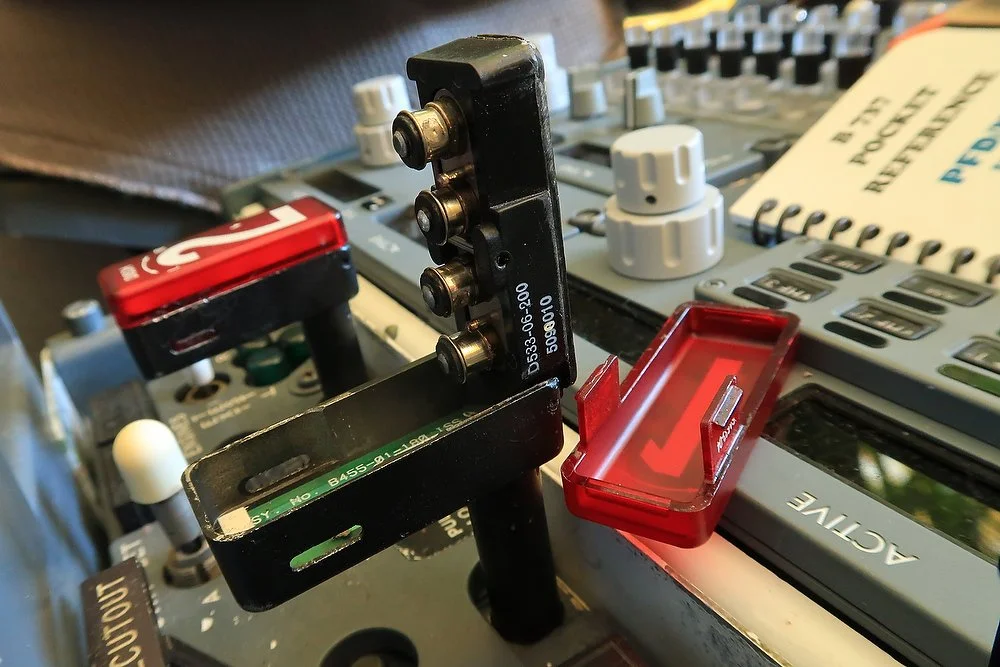
Spaces that do not have a panel installed are blanked off by what is called a blank. A blanking plate is piece of metal that fits the space and is secured to the pedestal rail by two or four DZUS fasteners. Some blanking plates are just that – a piece of metal, while others are metal backed with an acrylic cover (more upmarket in appearance).
The following panels are standard across all airlines that fly the Next Generation and are compulsory as per aviation regulations:
Mode Control Panel (MCP)
Electronic Flight Instrument System (EFIS)
Control Device Unit (CDU)
Navigation 1/2 Radio
Navigation 1/2 Radio
ADF 1/2 Radio
ADF 1/2 Radio
VHF Communication Radio 1
VHF Communication Radio 2
Transponder Panel
Stab Trim and Cabin Door Panel
Flood and Lighting Panel
Audio Control Panel (also called Audio Switch Panel/ASP)
Weather Radar Panel
Rudder Trim Module
Cargo Fire Panel
Fire Suppression Panel
The direction and length of this section does not subscribe to a discussion on various customised panels (airline specific). However, some custom panels are the phone panel, multi communications panel (VHF 1,2,3 and HF), Multi-Mode NAV Control panel, ACARS and the SelCal (selective calling) panel.
Avionics Selection
There is no recourse for complaint to the quality and appearance of a panel if you are using OEM. However, if using reproduction panels, your selection must be on par with your expectation; otherwise, your enjoyment level will plummet.
More importantly, any reproduction item purchased must be of the highest quality to ensure trouble-free, consistent, and reliable operation.
Important Point:
It's best to not mix and match reproduction avionics panels, unless you know for certain they are compatible with each other and the avionics used (proSim737).
Avionics - Glareshield and Center Pedestal
Glareshield
Mode Control Panel (MCP) - SimWorld
EFIS - Captain side and First officer - SimWorld
The Mode Control Panel (MCP) and Electronic Flight Instrument System (EFIS) are supplied by SimWorld in Poland. The main reason for selecting SimWorld was their accuracy in replicating the OEM MCP and their use of liquid crystal displays.
Previous to this, the MCP and EFIS were supplied by CP Flight in Italy. CP Flight produce some excellent reproduction components for the 737 and, more importantly, the company stands by the products they manufacture and sell. Their after sales and support service are usually excellent.
In the future, the MCP and EFIS will be replaced with an OEM unit, but this will not be in the immediate future.
Center Pedestal
The following panels have been installed to the center pedestal:
Radio Multi Communication Radio (M-Comm, VHF 1 & VHF 2) - FDS
ADF Radio (ADF 1) - FDS
ADF Radio (ADF 2) - FDS
Transponder panel - OEM
Weather Radar panel - OEM
Rudder & Aileron Trim panel -OEM
Audio Control Panel (ACP) Captain side - OEM
Audio Control Panel (ACP) First Officer side - OEM
EVAC Panel - OEM
Cabin Phone Panel - OEM
Fire Suppression Panel - OEM
In addition to the above, the flaps, brake pressure and yaw dampener gauges are OEM, while the fire suppression panel is from a 737-600 and the control display unit (CDU) is from a 737-500. It’s fortunate that many items used in the 737-500 are identical to those used in the Next Generation. The CDU differs marginally from it’s Next Generation counterpart, however, the difference is aesthetic.
It's very easy to become carried away with avionics and spend a small fortune on standby instruments and avionics panels. Therefore, a step/phase approach is a good idea when determining what you need.
Avionic Panels - Backlighting, Compliance and Colour
The main reason for trying to maintain consistency with avionics is that manufacturers of reproduction panels do not always manufacture identical panels. Size, ease of installation, material, computer connectivity, software, panel colour, and the type and colour of the back lighting can vary between manufacturers.
Flight Deck Solutions (FDS), CP Flight, SISMO, Open Cockpits and several other companies produce avionics panels that are more or less identical in size to their real life Boeing counterparts, however, the similarity ends there.
CP Flight use LEDS for backlighting whilst FDS use real aircraft bulbs (FDS call their propietry back lighting Integrated Back Lighting). OEM components mostly use 5 and 28 volt bulbs. Personally, I prefer the back lighting illuminated by incandescent bulbs because this is identical to that in a real Boeing aircraft. However, this comes at a cost - backlighting using 28 Volt bulbs runs very hot and can draw a considerable amount of power (amperage). Furthermore, mixing bulbs and LEDS can, because of their different colour temperatures, create a light imbalance which often can appear disconcerting and unappealing. Despite this, it’s often not possible to have one brand of avionics, so a compromise must be made.
A point worth noting, is that real aircraft rarely have the same brand avionics panels installed, or the same backlighting on each of the panels. Often there is a avionics mismatch as newer items are retrofitted to replace older style items. Therefore, a lighting imbalance is not unrealistic.
Similarly, it is not uncommon to observe different shades of grey used on various panels. Aircraft engineers are more concerned with getting the aircraft back into the air when replacing a panel, and they don’t care that the shade of grey the panel is painted is a slightly different hue to that of its neighbour.
The reproduction panels being used in the simulator are manufactured by Flight Deck Solutions, other panels OEM. In time, it is hoped to replace the reproduction panels with OEM components. I was using some CP Flight panels, however, decided to cease using them in favour of FDS.
Center Pedestal
The center pedestal, or aft electronics bay (sometimes called a P-8), is attached to the rear of the throttle quadrant. The primary purpose of the pedestal is a platform in which to accommodate the avionics panels.
Initially I purchased a 737-300 series two-bay center pedestal. However, soon after this purchase a 500 series three-bay center pedestal became available. The differences between the 737- 500 series pedestal and Next Generation is minimal.
dzus fasteners and rail
DZUS Fasteners and Rails
All panels are secured to the pedestal by DZUS fasteners. These fasteners allow a panel to be securely attached to the DZUS rail by a 90 degree quarter turn by a flat-blade screwdriver.
The DZUS fastener was designed in America in the 1930’s by William Dzus, a German immigrant. The fasteners are notable in that they are of an ‘over-centre’ design, requiring positive sustained torque to unfasten. Therefore, any vibration exhibited by the aircraft (turbulence, engines, etc) will tend to cause the fastener to correct itself (tighten), rather than loosen, as it would if a threaded fastener were used.
The fasteners are attached to a rail, which run the length of the inside of the pedestal. A three-bay pedestal will have six rails, while a two-bay will have four rails. The fire suppression panel, located between the throttle and the pedestal has two separate rails. The rails are made from aluminium.
Reviewed and updated 17 June 2020.