Main Instrument Panel (MIP) by Flight Deck Solutions - Review
/
Overview
The main instrument panel (MIP) is arguably one of the most important pieces of equipment in a flight deck; it is around the MIP that everything revolves. Every enthusiast wants the MIP to be athletically pleasing and as real to the OEM product as possible. Depending upon the end use, the MIP may act as a skeleton from which to add OEM parts, or standalone accommodating reproduction parts.
There are several companies that produce MIPS and each has its nuances. After extensive research, Flight Deck Solutions (FDS) in Canada was commissioned to supply the MIP.
Note that in this review, reference is made to the term OEM which is an acronym for Original Equipment Manufacturer (aka real Boeing 737 aviation part).
The image above is the Duel Seat Training Device offered by Flight Deck Solutions (image courtesy and copyright FDS).
Information - Not Pretty Pictures
This post is not intended to be an exhaustive review of the FDS MIP or the parts attached to the MIP. Rather, the intent of the review is to provide adequate information for enthusiasts to make an intelligent decision to which MIP to purchase.
Furthermore, it is important to understand that all reproduction simulator parts are exactly that - a reproduction or facsimile of a real part. Often reproduction parts are not to scale and have subtle differences to the real item. Whether this is important is at your discretion and very much depends upon whether you intend to use OEM parts or solely reproduction parts.
To view images of the MIP, navigate to the image gallery.
Interface cards have not been discussed for two reasons. First, there are several differing types of cards that can be used, and second, Integrated Cockpit Systems (ICS) units come ready-made with all wiring and interface cards installed.
ICS and Options
FDS provide two options when purchasing their MIP - naked (do it yourself) or as an integrated cockpit system (ICS).
The ICS route was chosen because of time constraints; by eliminated the task of wiring and soldering a multitude of interrelated electronic parts together, it would allow more time to concentrate on converting real aircraft parts to use in the simulator. At the forefront of the B737 project, the MIP was to be a skeleton from which to hang OEM parts.
The MIP consists of two sections; the main instrument display including the lower display and glare shields (eyebrows), and the base structure incorporating the CDU mounting area, lower display and stand.
FDS landing gear lever is a good facsimile of the real lever; however, the lever does not recess between the two half moons. Nor is the red trigger spring-loaded as in the OEM mechanism. Despite these aesthetic shortfalls, the landing gear functions well. The leather skirt is a step in the right direction concerning authenticity
UPPER MIP (Instrument Panel, Glareshield and Lower Panel/Kick Stand)
The panel is made from CNC machined acrylic and the glare shield from injection molded plastic. The panel and glare shields have been attached by screws to a light-weight powder coated aluminum frame which incorporates a 4 inch wide shelf on the rear side.
The cut-out lettering, which allows the lettering to be back-lit, is very crisp with well defined edges.
The panel has been professionally painted in Boeing grey. Although the panel is made from acrylic, the use of high quality flat paint removes the sheen that acrylic is renowned for. In comparison to other plastic-looking panels on the market, the colour and appearance is very true to form. It looks 'almost; like the OEM panel. and matches the real aircraft parts very well. Furthermore, FDS apply the paint in several thin layers which makes the coating very resistant to chipping and scratching.
Switches have been mounted in the correct locations and the wiring from these switches has been secured within a wiring lumen or by plastic cable ties. The switches and knobs replicate those of the real aircraft and have the correct feel, although the general purpose knobs (GPK) do not replicate the exact appearance of the OEM knob. Where a panel has not been included (not stock B737 configurations) a blanking panel has been fitted.
The soldering work and connections on all switches are excellent; it is more than obvious that the person who did the soldering work is a professional with many years experience.
The gear lever is sturdy and feels solid. To engage the landing gear, the lever must be pulled out of its recess and pushed up or down. The detail to the lever is excellent and installation includes the correct-looking fiber sleeve. The mechanism does not have the spring-loaded trigger; the trigger is a solid cast item attached to the lever.
Annunciator lights (six packs) and various warning lights are all functional; however, pale comparison to OEM parts and other high-end reproductions; they appear 'cheesy'. The glare shield is strong textured ABS plastic and wraps over the top of the MIP. A correctly sized chart pocket is screwed to the top of the shield. The two glares either side of the MIP on the Captain and First Officer side are painted MDF wood and although not have a negative appearance they do not replicate the appearance of the OEM glare which is made from textured foam plastic.
The shelf system, located behind the main instrument panel, is an excellent idea. The shelf, in addition to providing an area for the FDS monitor stands to be mounted, is a good platform to mount various cards, speakers and other items that may be required.
The FDS bracket, a novel design to hold the display units firmly in place. The display unit bezel is made from plastic and does not hinge outwards as the real bezel does. the knobs on the ISFD are not replicated
The lower display modules, which are mounted to the lower area of main panel, are installed using normal Phillips-head screws. In a real B737, panels and modules are usually secured using DZUS fasteners or skirted screws. It would have been a nice touch to have replicated the use of DZUS fasteners on the panels in the lower kick stand.
Display Unit Covers
The protective displays that the computer monitor screens (display units) are made from 1.5 mm thick perspex. I have found the perspex to be very reflective - especially so if the simulator is located in a well-illuminated room.
Integrated Back-Lighting (IBL)
Integrated back Lighting (IBL) is the name FDS has coined to refer to their proprietary design in which FDS utilise aircraft bulbs rather than LEDs. IBL is supplied to illuminate the back lighting in all FDS panels and modules.
One of the main advantages of a bulb in contrast to that of a LED is the throw of the light and the colour temperature. The area of coverage from bulbs is relatively even, where the coverage by an LED is more pinpoint and uneven. The only way to achieve a similar light coverage to bulbs using LEDs is to use several LEDS mounted in close proximity to each other.
One area that the use of bulbs excels is the rear illumination of the stencil-cut lettering on the MIP. Bulbs will completely illuminate the stencil cut-outs where LED lighting will often only illuminate part of the stencil cut-out (unless there are several LEDs).
Bulbs and LEDs have different colour temperatures. A bulb transmits a warm colour (soft orange hue) whereby a LED transmits a cooler colour that appears more blue in comparison.
All Boeing airframes, with the exception of the newest airframes utilise 5 and 28 volt incandescent bulbs.
The only downside of IBL (if there is one) is that the bulbs generate quite a bit of heat. The life of a bulb is also less than a LED.
Ground Proximity Panel showing use of Phillips head screws rather than the more usual DZUS fasteners
What the MIP Lacks
The non-use of DZUS fasteners in the lower panel (kick stand) and the failure to use skirted screws has been mentioned.
Stand-by instruments and clocks are not included. FSD supply a stenciled backing card which is mounted behind the perspex to mimic the look of the yaw dampener, brake pressure, clock and flaps gauge.
Considering the purchase price of a MIP, and considering the importance of a working flaps gauge, an operational analogue flaps gauge should be a stock item.
The avionics suite (Sim Avionics) can display virtual stand-by instruments id required.
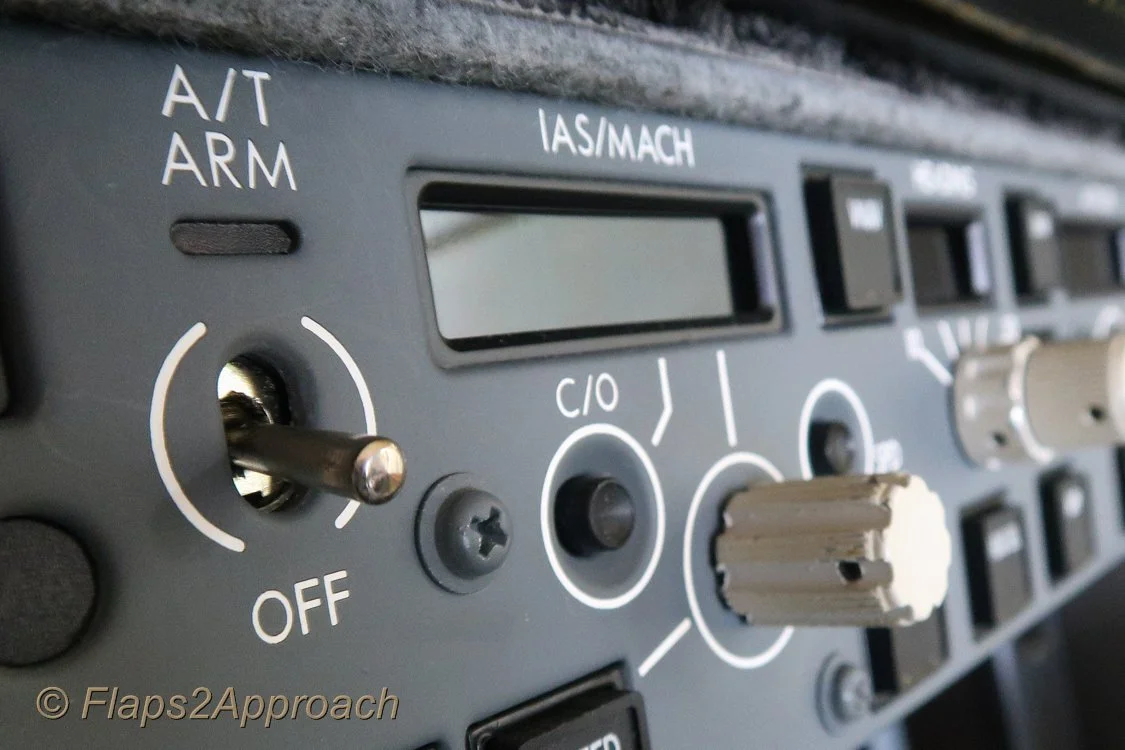
The speed reference panel and knobs are not functional. The knobs used in the speed reference panel do not replicate the OEM knobs used in the B737; the real aircraft uses double rotary encoder knobs. As with the flaps gauge, these knobs should be functional and, at least shoe some resemblance to the real part.
Software - Interface IT
The software to interface the MIP (InterfaceIT) seems to be well designed and robust. It does require a learning curve to become proficent with the software, but once proficent the siftware is logical in layout and use. Installation of the IT software is straightforward.
Additionally, there is a direct link between InterfaceIT and Sim Avionics which makes internal configuration and programming very easy.
Flight Avionics Suite
Duel Seat Training Devices (DSTD) and MIPS configured by Flight Deck Solutions use Sim Avionics as their flight avionics suite. After you receive your MIP, FDS staff will e-mail to you a file which you import into InterfaceIT. This file holds the data assignments for the MIP buttons and switches.
Although FDS recommend Sim Avionics, there is no obligation to use this software; the MIP will operate with whatever software you choose. A seperate post will deal with a review of Sim Avionics.
The rear shelf located behind the MIP and the propriety bracket used to hold the display units (computer screens) firmly in place. The bracket works exceptionally well and the shelf is very sturdy
Lower Base Structure
The base structure comprises the lower section of the MIP and includes the CDU bay structure and lower display screen. The structure is made from aluminum which has been professionally powder coated in Boeing grey.
As with the upper section of the MIP, the attention to detail is obvious. There are no sharp edges on the CDU bay structure, nor are there gaps where panels attach together. Screws match their holes correctly.
The DZUS rails that line the internal section of the CDU bay marry perfectly with the DZUS fasteners used to secure the Control Display Unit (CDU/FMC) to the rails. It does not matter whether a reproduction or OEM CDU unit is used as both will fit perfectly.
The lower display screen, which fits between the two gaps in which the CDUs reside, is identical in shape and manufacture to the upper display unit bezels. Unlike the three upper bezels in which a standard computer monitor can be mounted, the lower screen requires a smaller monitor which is not an off the shelf item.
clock panel showing backlighting during the day. the fabrication of this panel and button is very good as is the stenciling
Dimensions, 1:1 ratio and Using OEM Parts
The ability of a manufacturer to produce a MIP that is the correct 1:1 ratio to the real item cannot be underestimated. If an enthusiast is intending to only use instruments and panels produced by that manufacturer, then any size disparity is probably unnoticeable and probably not that important. However, if OEM parts are to replace reproduction parts, then the base sizing become crucial to the correct and easy fitment of an OEM part. In this area, the FDS MIP has some shortfalls.
The MIP has a number of holes and gaps that parts reside, for example for the AFDS and flaps gauge. If the holes are incorrectly matched to the OEM part, either a new panel (aluminum backing plate) will need to be engineered and painted, or the hole may need to be enlarged. Although enlarging a hole in a MIP is straightforward, the opposite is problematic and requires the design of a new panel.
Unfortunately, many of the holes in the FDS MIP do not correspond to the correct size when fitting OEM parts. For example, the holes that the AFDS units reside must to be enlarged considerably to enable OEM AFDS units to be fitted. Likewise, the holes to fit the annunciators need to be enlarged. The hole that the flaps gauge is housed is far too large and a new panel needs to be designed to gt an OEM flaps gauge.
Detail of the angled shelf used to accommodate the I/O cards. The multi-voltage computer power supply can also be seen mounted behind the perforated vents. The terminal block caters to 5 and 12 volts. The interface card is the FDS SYS card which comes standard with the ICS MIP
Power, System I/O Cards and Cabling
A multi-voltage computer power pack is used to power the MIP and has been mounted at the rear of the lower base structure.
The position chosen is well suited to internal wiring and allows easy access should a problem develop.
An angled shelf has been engineered to fit immediately behind the CDU bay. The design of the shelf is intended as an area on which to mount the various interface cards required to operate the simulator.
The interface cards required to operate the MIP have been secured to the angled shelf and all wiring has been expertly soldered or attached via solid electrical clips. Cabling and connections are of the highest quality. Each of the wires that are connected to the SYS board has been tagged with a plastic tag which indicates their function; a good idea if you need to change something at a later date or troubleshoot a particular problem.
There has been no compromises with regard to how the staff at FDS wired the MIP - it is beyond reproach.
3mm replacement side stand. The replacement stand inhibits any movement of the MIP as the structure is not (at the moment) installed within a shell
Base structure (side stands)
The base structure (stand) has been designed to be mounted either directly to a base platform. The mounting points are numerous holes along the lower angled edge of the stand. A concern was that the structure would wobble, as it is quite high and made from light-weight aluminum.
These concerns were short-lived; once each attachment point was secured with a screw the assembly was quite solid. This said, if you energetically engage the landing gear lever, there is a very slight movement in the upper area of the MIP. If you are mounting the MIP into a cockpit surround, any movement will cease as it will be attached to the outer skin of the shell.
To counteract any movement, it is a relatively easy matter to fabricate two replacement side stands from a thicker sheet of aluminum (3-5mm). This will guarantee that there will be no movement when manipulating knobs, the landing gear, etc.
Navigate to this post to read about the replacement side walls.
Communication, Support and Delivery
Communication with FDS was excellent. E-mails were always answered in a timely manner and Peter and Steven Cos are very professional in their approach. I was continually kept in the loop regarding construction and shipping.
Support if and when required is either via a dedicated forum, e-mail, or if necessary by telephone. Peter and Steve Cos very approachable and helpful and their support is second to none. I would go so far as to say that the support that FDS provides cannot be matched.
It is important to note that Flight Deck Solutions is not a mail order company with products in storage waiting to be shipped; products are assembled to order. This means that often there is a timely wait until you receive your shipment.
The MIP I had delivered to Australia was packed in and attached (screwed) to the floor of a large wooden crate. It arrived undamaged.
Quick List - Pros and Cons
PROS
Well designed & constructed
Excellent workmanship (metalwork and wiring)
Realistic and highly effective Integrated Back-Lighting (IBL)
Good functionality
Very clean appearance - wiring and cards favorably positioned
1:1 (or as near possible) to the real MIP (exception if using OEM gauges)
Moderate to high attention to detail
Robust & functional software (InterfaceIT) if using Sim Avionics avionics suite
Excellent paint quality (several layers of paint) that resists chipping and scratching
Outstanding support - the best in the industry
CONS
No analogue flaps gauge, other than virtual version (rectified by spending more money)
No stand-by instruments or clock (rectified by spending more money)
Non use of DZUS fasteners in lower panels above 'kick stand' (small things do make a difference)
RMI knobs are very low quality
Speed reference knobs are very low quality & do not replicate OEM B737 knobs
Landing gear lever does not recess behind shield when in down position
Landing gear does not utilise the spring trigger as in the real aircraft
Section between upper and lower MIP (kick-stand) is not the correct shape. It should be rounded and not be an angled piece of aluminum
Display unit covers are very reflective (easily rectified- remove or replace them with tinted displays)
Slightly inaccurate General Purpose Knobs (GPK) - poor stenciling on knobs
The MIP is not completely 1:1 and if using OEM parts, some engineering is required to fit OEM parts
The MIP is not an exact reproduction and artistic license has been taken in some areas (for example, the section between the upper and lower MIP (kick-stand). The MIP also lacks various screws and fasteners seen on the OEM MIP
Important Point:
If you are intending to add OEM panels, switches and knobs to the FDS MIP, be aware that many of the panels do not fit the FDS MIP. This is because the MIP frame is not exactly 1:1 with the OEM equivalent. In some instances (such as when retrofitting panels) the MIP is out by up to 1 cm. Also be aware that OEM korrys, flaps gauges and some of other avionics will not fit into the precut holes. You will need to either enlarge the hole or make it smaller.
FDS GPK with backlighting. The knob has a slightly different shape to OEM knobs. the adjustable propriety backlighting is perfect
General Purpose Knobs (GPK)
The GPKs are of high quality, however fail in a number of areas.
The black line is a manually applied adhesive which depending upon which knob you are inspecting, may or may not be quite straight. Being adhesive, with time the transfer lifts, especially at the ends. The translucent line between the black outer lines is not as bright as that observed in the real aircraft. Not all knobs have the transfers correctly aligned.
poor quality lower kickstand knobs. gpk showing excess plastic from manufacture process
The knobs are the incorrect shape and the grub screws are located in the wrong position on the knob. The knob also does not have an inside metal shroud (circular retainer). The retainer increases the longevity of the knob as it stops the acrylic from being worn down over time with continual use.
The knobs on the lower kick stand are also of poor quality bearing only a little resemblance to the OEM knobs
The knobs serve a function, but for the price of the MIP, knobs that reflect a more accurate representation would have been appreciated.
fds adf knob. WHY EVEN HAVE THIS AS IT IS NOTHING LIKE THE OEM RMI KNOB
RMI Selector Knobs
The knobs are made from acrylic with a transfer attached. The knob has no functionality and is attached to the MIP in a recessed hole. The RMI knob bears no resemblance to the OEM knob and is very poor quality.
Speed reference knobs are very low quality
Speed Reference Knobs (SRK)
The speed reference knobs supplied with the FDS MIP bear no resemblance to the OEM knobs. The OEM knob should be a double rotary encoder knob. There has been no attempt to replicate this type of knob.
Used Fuel Reset Switch
FDS have used a normal two-way toggle which is incorrect. There is no similarity to the OEM used fuel reset switch. The OEM toggle has a large bulbous head and is a specially-designed three-way toggle.
fds Boeing warning system. although functional the displays fall short of replicating the oem items
Autopilot Flight Director System (AFDS)
Although not an exact replica of the OEM part, FDS has done a good job replicating the functionality of the AFDS. Unfortunately, if you wish to replace the FDS unit with an OEM AFDS unit, the hole in the backing plate that attaches to the MIP will need to be enlarged considerably to allow correct fitting of the OEM component.
Boeing Warning System (six packs)
Compared to the OEM counterpart, FDS’s offering is lacking. The two warning buttons can be depressed very easily where the OEM buttons are quite firm requiring a good push. The six packs work quite well, however, lack adequate light coverage when a warning is displayed.
Annunciators (korry condition lights)
The FDS MIP uses LED reproduction annunciators (korrys). The LEDS are illuminated by two 5 volt LED lights which do not provide complete light coverage across the lens plate. The brightness of the LEDS is also not as bright as the OEM annunciators.
Furthermore, the hole in the MIP that the korrys reside is a tad on the small side; therefore, if you are intending to replace the reproduction korrys with Original Equipment Manufacture (OEM) annunciators, you will need to engineer the hole to a larger size. This is unfortunate as a MIP should be manufactured 1:1 to allow reproduction parts to be replaced with OEM parts.
on the oem landing gear the red trigger sits flush with the two half moons
Landing Gear Lever
The landing gear lever requires more explanation.
In the real B737-800 NG the landing gear handle sits closer toward the main instrument panel. The half circular shield is designed so that the red-coloured gear trigger sits between the two half moon shields when the lever is in the DOWN position. In the FDS version, the trigger sits too far out from the front of the MIP and the trigger is not protected by the two shields.
Furthermore, the trigger is not spring-loaded as in the OEM mechanism; it is a solid piece of metal.
Lights Test / DIM Switch
A normal two-way momentary toggle is used which is incorrect. The OEM switch is a three way non-momentary switch which allows the switch to be placed in any one of three positions. The OEM toggle is also large than a standard toggle switch.
To see additional photographs of the Flight Deck Solutions MIP.
Final Call
The MIP is well made and has been finished with obvious care; parts line up correctly, screw heads have not been burred and paint not chipped. Wiring, soldering, parts, switches, paint, colour, rotaries, blanking panels and display frames are of the highest quality. It is obvious you are dealing with a premium product that provides an very good facsimile of a 737-800 instrument panel.
Downside is the lack of any hard-wired gauges, poor quality speed reference and general purpose knobs, lack of DZUS in lower panels, no flaps gauge, and a wrongly positioned landing gear lever (when in the down position). Another issue is that the MIP is not 1:1 with its OEM counterpart, nor is it a 100% accurate rendition of an OEM MIP.
This said, for many enthusiasts this will not be an issue as the differences are minor. If you intend to use OEM parts then some parts of the MIP will need to be fabricated to enable the real parts to fit snugly into the MIP.
Depending upon your end use - a MIP with reproduction gauges, or a MIP skeleton to hang OEM parts - your views will alter. Certainly, the FDS MIP is not to be discounted as a premium product; it is a pity that FDS did not take a few extra steps to make this MIP the 'Queen of the crop.
The closest rival to the FDS MIP is the MIP manufactured by Fly Engravity and SimWorld. Other MIPS are available from other companies, but the FDS MIP, although lacking in some areas is superior in many ways.
Rating is 7.5/10
Please note that this review is my opinion only.. Furthermore, note the date of the review. Flight Deck Solutions may have updated their MIP after this review has been published.
Thanks to Peter Cos, Flight Deck Solutions for allowing the use of the front image.
NOTE: Before taking what you read as gospel, check the FDS website in case these shortcomings have been rectified since this post was published.